On 11 November 2026, the European Commission proposed a package to reshape EU consumer law for the digital economy: a Digital Fairness Act (“DFA”). This new EU Regulation would replace the Unfair Commercial Practices Directive; amend the Consumer Rights Directive; and revise the Consumer Protection Cooperation (“CPC”) Regulation to give the Commission direct enforcement powers.
The European Parliament and Council will now negotiate on the draft text amid industry lobbying, with the final text not expected to be in force before 2028. But the direction of travel is clear enough for consumer-facing businesses to factor in compliance implications.
Key Takeaways
-
Design becomes regulated conduct. Dark patterns, addictive features, subscription flows, personalised advertising and pricing all attract specific requirements, not just disclosure duties.
-
Contracts and terms will need review. Free trials, auto-renewals and cancellations are regulated: a free trial cannot convert into a paid contract without a customer reminder and the customer’s express agreement, customers can terminate free of charge if a renewal reminder is missed, and companies must offer an online “terminate the contract” function and access to a human in customer service. Businesses will need to review their standard T&C’s and their sign-up, renewal and cancellation journeys.
-
Enhanced enforcement powers. Where the Commission investigates (likely for large cross-border cases), it can impose fines of up to 6% of worldwide annual turnover. In cross-border cases, national authorities must be able to impose maximum fines of at least 4% of the trader’s annual turnover in the Member States concerned.
-
Agentic AI is in scope. The DFA proposes dedicated rules for AI agents that buy on a customer’s behalf and other automated processes, and chatbots that nudge continued engagement fall within the addictive-design rules.
-
Cost to business is real. The Commission estimates recurring costs to businesses of EUR 1.2 billion a year (EUR 678 million adjusted for overlaps between the different measures in the DFA) against EUR 13.7 billion of annual consumer detriment avoided by the proposals. It presents the package as positive for consumers and businesses alike: one directly applicable rulebook and a level playing field.
What the Proposal Would Do
The DFA will apply to all business-to-consumer commercial practices, offline and online, including those of non-EU traders targeting EU consumers. If enacted, it will carry over the existing consumer rules on misleading and aggressive practices and add a new Chapter III on digital fairness:
-
Dark patterns (Art 10, Annex I). A general ban on interfaces likely to deceive, manipulate or materially distort consumers’ economic behaviour, plus a list of practices unfair in all circumstances. False “almost sold out” claims are the Commission’s headline example.
-
Event ticketing and virtual queues (Arts 18 and 19). Dynamically priced event tickets must disclose how many are available at the advertised price and the maximum price. Resellers must show the original ticket price. Virtual queues must show the live price, whether it may change and the highest possible price.
-
Addictive design and games (Arts 14 to 17). Consumers must be able to switch off autoplay, non-interaction notifications and streak-style engagement incentives. Paid loot boxes need odds disclosure and an off switch. Where a product is directed at or known to be used by minors, loot boxes and pay-to-win or pay-to-progress mechanics are banned, and paid virtual currencies are off by default.
-
Influencers (Art 11). Content must be labelled “advertisement” or “commercial collaboration”, with no direct exhortations to minors. Influencer marketing of unsafe products, or of products that cannot lawfully be advertised, is prohibited. Brands and agencies using influencers must ensure that influencers comply, by contract or, where there is none (for example gifts or invitations), by other effective and proportionate measures such as providing clear rules, checking disclosure and requiring correction or removal.
-
Personalisation (Arts 12 and 13). No profiling-based advertising to minors or using sensitive personal data (as defined under the GDPR), and no personalised pricing reasonably likely to harm known minors or vulnerable consumers.
-
Subscriptions and contracts (Arts 20 to 25). A reminder and express consent are needed before a free trial becomes paid, or the consumer is not bound. Auto-renewals need a prior reminder (at least 14 days but no more than one month ahead for contracts of six months or more, and at least one week ahead for contracts of less than six months). Traders must offer “terminate the contract here” and withdrawal buttons, and a human in customer service on request.
-
Simplification. Reduced pre-contractual information for repeat in-app purchases (companies need only provide the main characteristics and the price, not the full information package required by the Consumer Rights Directive); for digital media subscriptions, the 14-day withdrawal right becomes a right to cancel in the first month on payment of that month’s fee.
-
Anti-circumvention. Companies may not undermine compliance by contractual, commercial, technical or other means, including behavioural techniques or interface design.
Minor Protection and AI Agents / Chatbots
Two cross-cutting themes emerge from the proposal and are likely to attract the most political and regulatory attention.
-
Minor protection. A minor is anyone under 18. Protections for minors are built into many provisions (addictive design and games; influencers marketing; personalisation and in-app spending), so businesses with young users, or with products or content aimed at them, face a distinct set of requirements. For instance, where a product is directed at minors, or the trader is aware with reasonable certainty that minors use it, paid virtual currencies are disabled by default and need parent or guardian approval.
-
AI agents and chatbots. The Commission presents the DFA as “technology-neutral”. AI-generated offers, AI-driven personalisation and chatbot sales prompts are caught by the misleading, aggressive, dark-pattern and personalisation rules in the same way as other tools. Two provisions are AI-specific. First, for AI agents that conclude contracts on a consumer’s behalf (Art 26). Second, features that simulate relationships, such as persistent prompts to keep engaging with a chatbot or AI companion, must be capable of being switched off (Art 17(1)(d)).
Enforcement and Liability
Converting the Directive into a Regulation replaces 27 national regimes and is the legal precondition for Commission enforcement. EU national courts and administrative authorities may order disclosure of evidence on the design, operation and impact on consumer behaviour of a practice, and may treat a failure to disclose as relevant to unfairness (Art 34). Consumers may claim compensation (Art 32) and a liable trader may seek recourse against commercial partners whose conduct contributed to the breach (Art 36).
Supervision of the minors and addictive-design rules is shared with DSA, AI Act and proposed EU KIDS Act authorities (Art 30(5) to (7)), so several authorities may be involved and some DFA rules do not apply where another regime already covers the same practice (i.e., Art 12 does not apply to online platforms already bound by the equivalent DSA prohibition and the minors and addictive-design rules in Arts 14 to 17 give way to the proposed EU KIDS Act for the services it covers).
U.S. and UK Perspectives: A Comparative View
Most digital and consumer-facing companies will need to comply with the DFA alongside UK and US rules, which overlap with it in some areas and diverge in others.
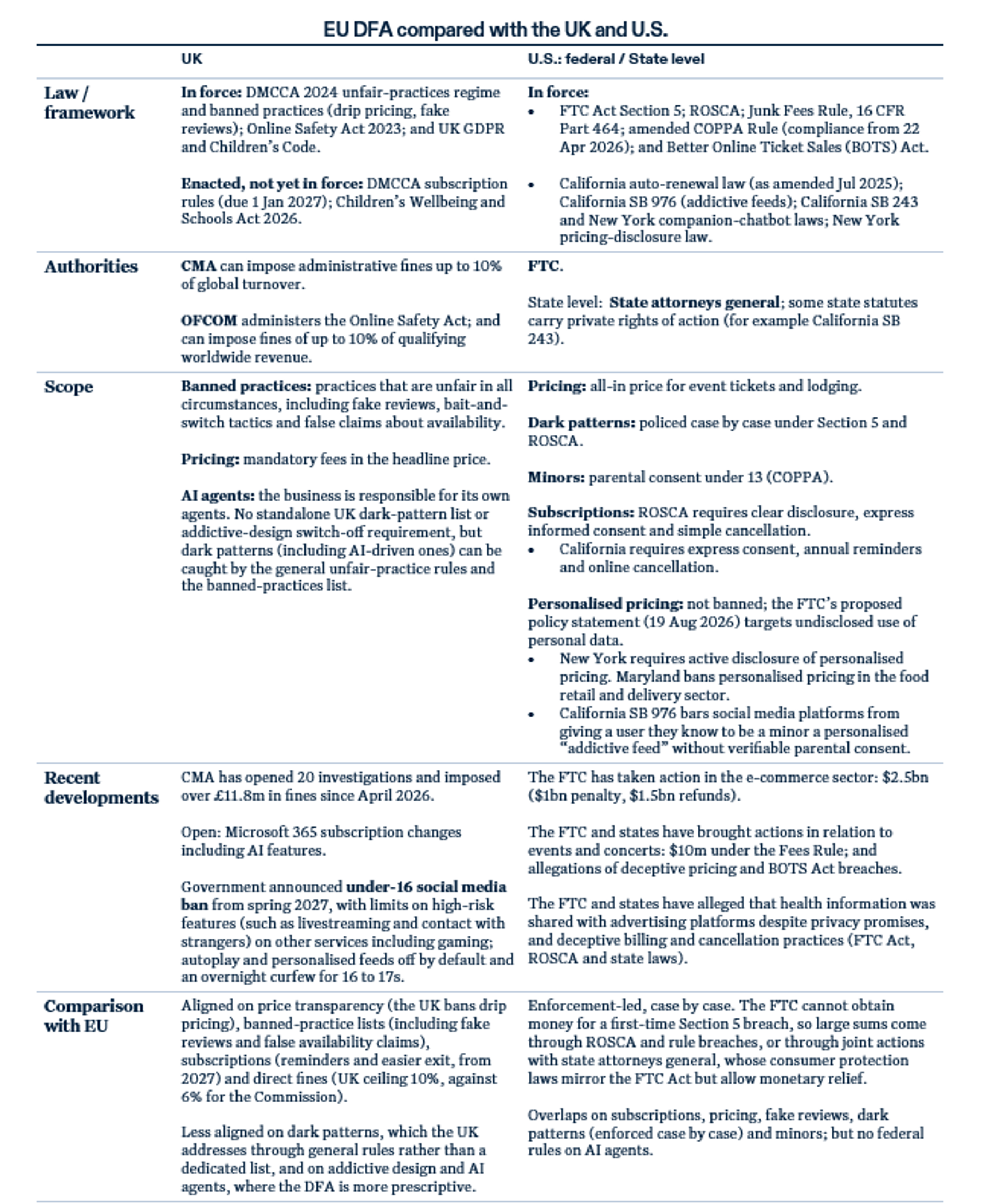
What the comparison means
-
Convergence on the need to regulate, divergence on method. Price transparency and subscription exit are now regulated, or about to be, in all three. One global baseline (all-in headline price, express consent to renewal, pre-renewal reminder, one-step cancellation) will satisfy most of each regime, but parameters differ.
-
Exposure turns on the enforcement model, not the headline fine. The UK ceiling is 10%, but the first three fines were 0.07% to 0.6% of turnover after settlement discounts. In the U.S., the FTC cannot fine first-time Section 5 breaches, but can lead to penalties and refunds. EU level of enforcement to be tested, but potentially severe.
-
Children are the centre of gravity, but each jurisdiction pulls a different lever. Minor protection now runs across social media, games, chatbots and advertising, but each jurisdiction uses a different tool. The UK is moving to restrict access (an under-16 social media ban, limits on high-risk features on other services, including gaming, default protections for 16 to 17s and a ban on sexualised AI chatbots for under-18s); the EU DFA regulates specific commercial practices (influencer marketing, profiling, in-game spending and loot boxes), leaving age-appropriate design to the proposed EU KIDS Act; and U.S. states legislate on feeds, app stores and chatbots, subject to FTC litigation.
* * *
Related Insights