On August 7, 2026, the Committee on Foreign Investment in the United States (“CFIUS” or the “Committee”) released its Annual Report to Congress for calendar year 2025 (the “Report”).[1] In an accompanying press release, the U.S. Department of the Treasury (“Treasury”) highlighted the Committee’s operational resilience during appropriations disruptions (i.e., a government shutdown) and its continued focus on facilitating secure investment. The Report covers the Committee’s review or assessment of 347 covered transactions—207 notices and 140 declarations—and comes alongside Treasury’s July 29, 2026, launch of a modernized CFIUS.gov website featuring new pre-filing consultation tools and a published risk matrix.[2]
Although comprising largely statistical information and not providing details on transaction-specific considerations, the Report—paired with Treasury’s parallel efforts to enhance transparency—offers a number of insights into the Committee’s operations, enforcement posture and evolving approach to facilitating investment.[3]
We explore the key takeaways below.
Treasury Delivers on the America First Investment Policy’s Promise of Enhanced Efficiency and Transparency
On July 29, 2026, just days before releasing the Report, Treasury launched a redesigned CFIUS website highlighting key promises of President Trump’s America First Investment Policy (“AFIP”) issued in February 2025.[4] As we discussed in a prior alert, the AFIP directed CFIUS to create an expedited “fast-track” process for investment from allies and partners to enhance its “customer service” for the investment community and to modernize its engagement with transaction parties.[5] The new CFIUS.gov is the most visible manifestation of these directives to date, which Treasury Secretary Bessent described as significantly upgrading the Committee’s customer service.[6] The most significant additions include:
-
Pre-Filing Consultations Portal. A new portal allows parties to ask questions and submit information about their transactions before a formal filing—potentially valuable when parties believe the Committee would benefit from additional context regarding a given transaction. Parties should temper expectations about what the portal will yield, however. It expressly states that CFIUS does not issue advisory opinions—including on whether a transaction is a covered transaction, whether it may raise national security concerns or whether a mandatory filing is required. In other words, any staff feedback is non-binding.[7] That position is long-standing, not a feature of the redesign.[8] The portal is therefore best understood as formalizing a channel for processing questions and for supplying transaction context, not as a mechanism for obtaining jurisdictional, mandatory filing or risk determinations.
-
High-Level Risk Matrix. The portal publishes a matrix identifying eight categories of elevated national security risk—critical infrastructure, cybersecurity, information security, personal data security, product integrity, proximity concerns, supply assurance and technology transfer—with an illustrative list of sample mitigation measures for each. Though general, it is the most concrete public guidance CFIUS has offered on how it categorizes risk and gives the public a government-published reference for pre-filing assessment.
-
OIS Initiatives and Enforcement Pages. Dedicated pages describe Office of Investment Security (“OIS”) initiatives, including the Investment Security Technology Initiative and the Strategic Vendor Program. The portal also now hosts the Report itself, as well as an expanded enforcement page.
Beyond the website, Treasury launched the Known Investor Pilot Program in 2025 to collect detailed information from allied and partner investors in advance of filing, implementing the AFIP’s “fast-track” directive.[9] Treasury also signed a Memorandum of Understanding with the Department of Agriculture formalizing USDA’s CFIUS role for agriculture-related transactions and committing to improved information sharing on foreign investments in agricultural land.[10] Additionally, Treasury established an Office of Research and Analysis within OIS—an in-house technical branch of scientists, engineers and data experts dedicated to reviewing foreign investments.[11]
The Declaration Program Continues to Draw Filings, but Clearance Rates Declined
A product of the Foreign Investment Risk Review Modernization Act of 2018 (“FIRRMA”), the declaration program provides parties a “short-form” filing option evaluated on an expedited 30-day timeline.[12] It drew 140 filings in 2025 (its highest level since 2022), though still short of the 164 filed in 2021—of which 51 were subject to FIRRMA’s mandatory filing requirements.[13]
The 2025 data nonetheless reveal a less favorable outcome profile for declarations than in recent years. The Committee concluded all action (i.e., cleared the transaction) on 66% of declarations, down from 78% in 2024 and 76% in 2023, while the rate at which CFIUS requested a full notice filing jumped to 26%—the highest since 2022’s 32%.
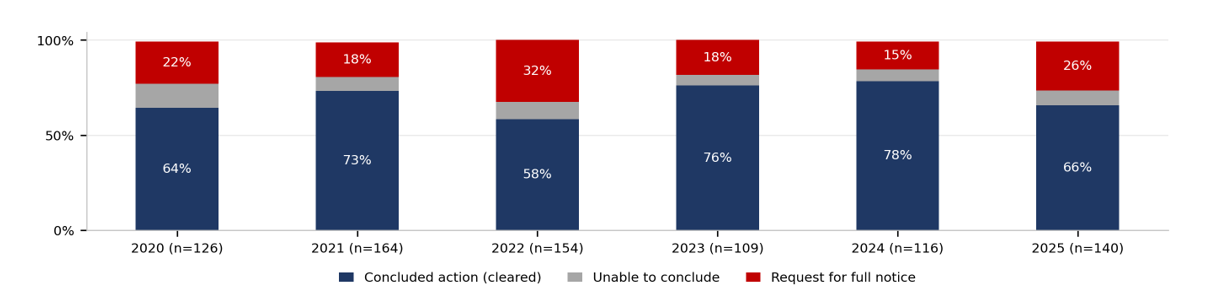 |
Figure 1: Declaration outcomes, 2020–2025. Source: Report, Table I-1.
This reversal may reflect the lingering effects of the appropriations lapses or a shift in the perceived risk profile of filings. Whatever the cause, parties should not assume 2024’s clearance rate will be replicated: averaging the last four years, approximately 24% of declarations resulted in a notice request.
The practical consequence is one of sequencing rather than probability. The Committee used essentially the entire assessment period in 2025, averaging 30.1 calendar days with a median of 30.0.[14] An unsuccessful declaration therefore does not simply fail; it consumes roughly a month (plus preparation time) before the 45-day notice review begins, with a further 45-day investigation possible after that. Where timing is critical and the transaction is anything other than plain vanilla—for instance, a critical technology or sensitive data nexus, foreign government ownership, an opaque ownership chain or U.S. government contracts—it may be preferable to initiate the review by full notice rather than risk losing 30 or more days to a declaration that ends in a request for a notice. CFIUS’s new filing guidance page addresses these considerations directly and is a useful reference in making that call.[15]
2025 Filing Volumes Rebounded Despite Operational Disruptions
In 2025, parties filed 207 notices and 140 declarations, for a total of 347 covered transactions reviewed or assessed—an increase from 325 in 2024, following two consecutive years of decline from the post-FIRRMA peak of 440 filings in 2022.[16] As with the prior year’s downtick, the modest rebound likely has more to do with global M&A activity than with any change in CFIUS’s scope of review.[17]
This rebound occurred despite extraordinary disruption. Three lapses in appropriations affected the 2025 reporting period: (1) a government-wide lapse from October 1 to November 12, 2025; (2) a lapse affecting Treasury and several other CFIUS member agencies from January 31 to February 3, 2026; and (3) a lapse affecting certain components of the Department of Homeland Security from February 14 to April 30, 2026.[18] Together, these events forced the tolling of statutory case deadlines for more than 120 days in total and delayed the Committee’s ability to accept new filings. The Report acknowledges that these disruptions created uncertainty for investors and businesses that depend on a predictable review process. The Committee nonetheless cleared 67% of covered transactions within the initial assessment or review period—although that figure, like every timing metric in the Report, is calculated net of tolled days and so it may understate the transaction party experiences.[19] Transaction timetables should account for that risk.
Timing Improved, but Lengthy Reviews Persist
The Committee continued to meet its obligations on processing timelines. For notices filed in 2025, the average time to close in review was 45.4 calendar days (median 45.0) and to close in investigation 82.8 days (median 91.0). The Committee provided comments on draft notices in an average of 5.35 business days and accepted formal notices in 3.44 business days, both within the 10-business-day benchmark.[20]
These headline numbers mask the continuing reality that many transactions face extended timelines. Of the 207 notices filed, 114 (approximately 55%) progressed into the second 45-day investigation period, consistent with 2022–2024 and continuing a reversal of the pre-2022 trend in which most notices cleared during the initial review.[21] Moreover, 61 notices were withdrawn, 58 after commencement of investigation; the post-investigation withdrawal rate rose to 28% from 23% in 2024, the highest withdrawal rate since 2022. Parties refiled in 51 cases (37 in 2025 and 14 in 2026), meaning those transactions faced processes well in excess of 90 days.[22]
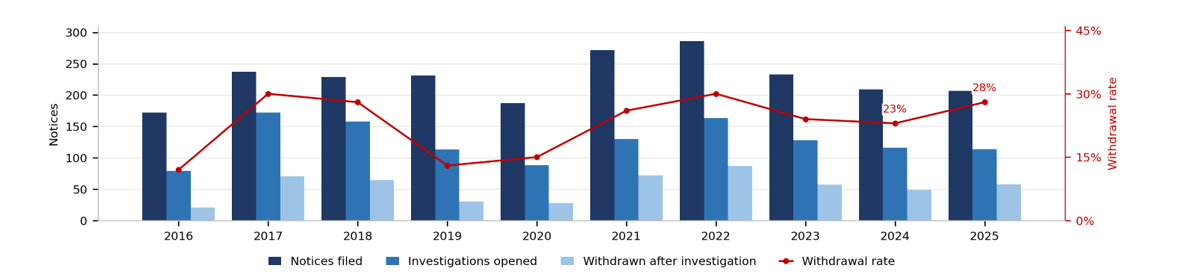 |
Figure 2: Notices, investigations and post-investigation withdrawals, 2016–2025. Source: Report, Table I-5.
As in prior years, parties to complex transactions should anticipate processes extending well beyond 90 days.
Mitigation Rates Continue to Decline, Signaling More Definitive Outcomes
CFIUS entered into or imposed mitigation measures or conditions with respect to 25 notices in 2025—approximately 12% of total notices—of which 15, or approximately 7%, were mitigation agreements entered on clearance.[23] This continues a notable downward trend: in 2023, the Committee required mitigation in 35 cases, or approximately 21% of distinct transactions.[24]
The decline is consistent with the direction set by the AFIP, which instructed CFIUS to cease using “overly bureaucratic, complex, and open-ended” mitigation agreements in favor of concrete actions that companies can complete within a specific time frame.[25] Because the AFIP was issued in February 2025, most of the year’s caseload was reviewed after it took effect—though the trend was already visible in the 2024 data, suggesting the Committee was moving in this direction beforehand.[26]
Meanwhile, presidential decisions were issued with respect to two transactions in 2025, which prohibited the acquisitions and required divestment.[27] Combined with the declining mitigation rate, this may signal more binary outcomes—transactions increasingly either cleared without mitigation, were abandoned or were prohibited, with fewer resolved in the “cleared-with-mitigation” middle ground.
The Report also offers some color on how the Committee is managing its existing portfolio of agreements, which bears directly on parties already operating under mitigation. Of the 234 agreements and conditions under monitoring at year-end, 23 were terminated during 2025 while only four were materially modified.[28] Terminations thus outpaced material modifications by nearly six to one, and the portfolio contracted on a net basis from the 242 agreements monitored a year earlier.[29] The pattern suggests the Committee is retiring legacy obligations outright rather than renegotiating them incrementally—an approach consistent with the AFIP’s instruction to move away from open-ended agreements.
Enforcement and Non-Notified Detection Continue to Intensify
As of year-end, CFIUS was monitoring 234 mitigation agreements and conditions. Agencies conducted 40 site visits—down from 79 in 2024, likely reflecting the operational constraints of the appropriations lapses rather than a shift in compliance posture. The Committee also issued two formal determinations of noncompliance with the mandatory filing obligations and continued to investigate voluntary self-disclosures of potential filing failures.[30] Notably, the Report does not disclose any new civil monetary penalties assessed in 2025—a contrast with the record five penalties publicly announced for 2024. The absence likely reflects these same operational disruptions rather than a retreat from enforcement.
On the non-notified front, the Committee identified thousands of potential non-notified transactions in 2025, investigated 90, opened official inquiries into 62—compared with 60 in 2023—and requested filings for nine; two additional parties filed voluntarily after receiving outreach.[31] The Report notes that non-notified transactions remain among the most complex the Committee considers, and that it continues to enhance detection through additional staffing, new datasets and interagency coordination—building on the non-notified authorities Congress provided in FIRRMA.
Failing to file is not always a safe strategy: presidential divestment orders issued years after closing demonstrate the potential worst-case consequences of non-notification. Companies should evaluate carefully whether a mandatory filing requirement applies, and whether a voluntary filing may be prudent.
The Caseload Shifted Toward Hardware, and Allied Investors Shifted Toward Declarations
Excluding real estate filings, the 200 notices in 2025 were concentrated in Finance, Information and Services (99) and Manufacturing (79, or approximately 40%)—Manufacturing’s highest share since 2019.[32] The movement within subsectors is more striking: semiconductor and other electronic component manufacturing accounted for 17 notices, up from four in 2024, and aerospace products and parts rose to 13 from six, while electric power generation declined to seven from 11 in 2024, and scientific research and development services held roughly flat at 12 (up slightly from 10 in 2024). Sponsors in semiconductor, aerospace and precision instrument supply chains should assume their transactions sit within the Committee’s current focus.
Investors from China again accounted for the highest number of notices, with 33 (approximately 17%), consistent with 2023 and up from 26 in 2024; over 2023–2025, China leads cumulatively with 92 notices (14%), ahead of Japan (62) and the UAE (61).[33] The declaration program, by contrast, remains dominated by allies and partners—France, Singapore, South Korea and the United Kingdom each filed more declarations than notices, and Singapore rose from zero declarations in 2023 to 13 in 2025, while China filed five.
The “critical technology” data cut against a common assumption. CFIUS reviewed 166 covered transactions involving U.S. critical technology companies in 2025, but the leading acquirer jurisdictions were Japan (20), France (16), Israel (15) and Germany (13); China accounted for eight (8).[34] In volume terms, transactions involving critical technology are overwhelmingly an allied-investor phenomenon.[35]
Reading the Country Data: What the Report Does and Does Not Show
Chinese-investor filings remain substantial in number, but the trend line is flatter than it may first appear. Notices from Chinese acquirers totaled 33 in 2025, up from 26 in 2024 yet level with the 33 recorded in 2023; declarations rose from two to five.[36] The three-year pattern is therefore a rebound to 2023 levels rather than a secular increase.[37]
On how those filings fared, the Report does not disaggregate clearances, mitigation or prohibitions by acquirer country, so it cannot answer the question directly. Two indirect indicators are available. First, although Chinese investors led total notice volume, the Report identifies Japan, the UAE and Canada as the leading sources on a distinct-transaction basis—which counts withdrawn-and-refiled notices only once.[38] That Chinese investors do not appear on that list despite leading raw volume implies their filings were disproportionately withdrawn and refiled, the pattern associated with contested reviews and protracted mitigation negotiations. Second, both presidential orders prohibiting a transaction and requiring divestment in this period involved China-controlled acquirers.[39] The available evidence thus points toward longer and more adverse outcomes for China-related filings, but it is inferential rather than reported.
Canada, by contrast, has not seen the decline that current bilateral friction might suggest. Canadian notices rose to 15 in 2025 from 12 in 2024, approaching the 16 filed in 2023, and Canada ranks third on the Report’s distinct-transaction basis—ahead of every European filer. Canadian declarations did soften, from 13 in 2023 to 11 and then nine.[40] Canada therefore remains the fourth-largest source of notices and among the top three sources of distinct transactions.
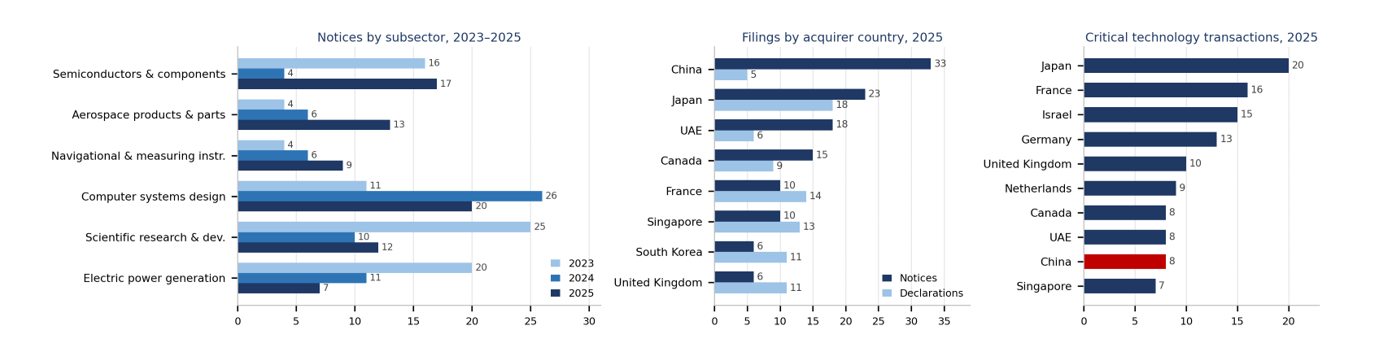 |
Figure 3: Notices in selected subsectors, 2023–2025 (left); notices and declarations by foreign acquirer home country or economy, 2025 (center); and covered transactions involving U.S. critical technology companies by foreign acquirer home country or economy, 2025 (right). Source: Report, Tables I-3, I-12, I-13 and II-1.
Conclusion
CFIUS’s annual reports continue to provide a useful tool for understanding the operations of a regulatory process that otherwise remains largely shrouded from public view. The 2025 Report, read alongside the launch of a modernized CFIUS.gov website and the ongoing implementation of the AFIP, shows a Committee navigating institutional evolution—balancing the administration’s stated goal of welcoming investment from allies and partners against continuing, and in some respects intensifying, scrutiny of transactions. CFIUS remains an active, well-resourced regulator that reviews hundreds of transactions per year, screens thousands for non-notified transactions and is increasingly willing to use its enforcement and blocking authorities, even as the new CFIUS.gov tools and the Known Investor Program represent genuine efforts to reduce friction for lower-risk transactions.
* * *
[1] U.S. Dep’t of the Treasury, Press Release, Treasury Releases CFIUS Annual Report for 2025 (Aug. 7, 2026), available here.
[2] U.S. Dep’t of the Treasury, Press Release, Treasury Unveils Redesigned CFIUS Website (July 29, 2026), available here.
[3] U.S. Dep’t of the Treasury, Committee on Foreign Investment in the United States: Annual Report to Congress, Report Period: CY 2025 (2026) (hereinafter the “Report”), available here.
[4] The White House, America First Investment Policy (Feb. 21, 2025), available here.
[5] See Paul, Weiss, White House “America First Investment Policy” Directs Changes to CFIUS and Outbound Investment Programs (Mar. 10, 2025), available here (anticipating that the AFIP’s directives regarding enhanced transparency and a “fast-track” process would require significant operational changes at CFIUS).
[6] U.S. Dep’t of the Treasury, Press Release, Treasury Unveils Redesigned CFIUS Website (July 29, 2026), available here.
[7] Pre-Filing Consultations, CFIUS.gov, available here (stating that CFIUS does not issue advisory opinions as to national security concerns, coverage under 31 C.F.R. part 800 or 802 or applicability of the mandatory filing requirement under 31 C.F.R. § 800.401 and requiring parties to acknowledge that staff feedback is non-binding). Consultations should occur at least five business days before a declaration or draft notice, and submissions are confidential under Section 721(c).
[8] Treasury’s filing instructions have long stated that CFIUS does not issue advisory opinions and will not review draft declarations. See, e.g., Voluntary PART 800—REGULATIONS PERTAINING TO CERTAIN INVESTMENTS IN THE UNITED STATES BY FOREIGN PERSONS, U.S. Dep’t of the Treasury, available here.
[9] Report at viii.
[10] Report at viii–ix; see also Paul, Weiss, 2025 Year in Review: National Security (Jan. 23, 2026), available here.
[11] Report at ix.
[12] Foreign Investment Risk Review Modernization Act of 2018, Pub. L. No. 115-232, div. A, tit. XVII, § 1701 (Aug. 13, 2018), 132 Stat. 2174. FIRRMA expanded CFIUS’s jurisdiction, created the abbreviated declaration process, introduced mandatory filing requirements for certain transactions and strengthened the Committee’s authority to identify non-notified transactions; the implementing regulations took full effect on February 13, 2020. See Report at 4 n.2.
[13] Report at 5.
[14] Report at 12 (Table I-4).
[15] Filing Guidance, CFIUS.gov, available here (addressing declaration-versus-notice considerations and common sources of delay). Response deadlines also differ: follow-up requests are generally due within two business days on a declaration, against three on a notice.
[16] Report at 5, 14–15.
[17] See Paul, Weiss, 2025 Year in Review: National Security (Jan. 23, 2026), available here.
[18] Report at 16. For operational detail on how CFIUS reviews are affected during lapses in appropriations, see Paul, Weiss, Update: The Federal Government Shutdown (revised Oct. 27, 2025), available here.
[19] Report at viii, 16.
[20] Report at 16.
[21] Report at 14–15.
[22] Report at 30.
[23] Report at 31.
[24] See Paul, Weiss, CFIUS Releases 2023 Annual Report, Highlighting Enforcement Activity (Aug. 14, 2024), available here. The 2023 figure is expressed as a share of distinct transactions, whereas the 2025 percentages in the text are shares of total notices filed; the comparison is therefore directional.
[25] See Paul, Weiss, White House “America First Investment Policy” Directs Changes to CFIUS and Outbound Investment Programs (Mar. 10, 2025), available here.
[26] See Paul, Weiss, 2024 Year in Review: CFIUS, Outbound Investments and Export Controls (Dec. 06, 2024), available here.
[27] For a discussion of these orders, see Paul, Weiss, Executive Order Requires Chinese Owners to Divest From U.S. Technology Company (July 21, 2025), available here (discussing the Suirui/Jupiter divestment order); Paul, Weiss, DOJ Files First-Ever Complaint to Enforce Presidential Divestment Order in CFIUS Matter (Feb. 18, 2026), available here (describing DOJ’s subsequent enforcement action). The second presidential order, issued January 2, 2026, required HieFo, a Delaware corporation controlled by PRC citizens, to divest interests acquired from EMCORE Corporation. See Paul, Weiss, 2025 Year in Review: National Security (Jan. 23, 2026), available here.
[28] Report at 38.
[29] U.S. Dep’t of the Treasury, CFIUS Annual Report to Congress, Report Period: CY 2024 (2025), at 39, available here; see also Paul, Weiss, 2024 Year in Review: CFIUS, Outbound Investments and Export Controls (Dec. 06, 2024), available here.
[30] Report at 38.
[31] Report at 39. The Committee opened formal non-notified inquiries into 60 transactions in 2023, requesting filings in 13. See Paul, Weiss, CFIUS Releases 2023 Annual Report, Highlighting Enforcement Activity (Aug. 14, 2024), available here.
[32] Report at 17, 19–20, 23–25.
[33] Report at 26.
[34] Report at 42–43. “Critical technologies” is defined at 31 C.F.R. § 800.215 by reference to U.S. export control regimes, which sweeps in a substantial volume of commercially ordinary activity.
[35] However, that aperture may widen. In the National Security Science and Technology Strategy released on August 17, 2026, the Administration stated that it will seek, in consultation with Congress, to expand CFIUS’s critical technology jurisdiction and to monitor certain greenfield investments posing acutely high potential risks to national security. See Exec. Office of the President, Office of Sci. & Tech. Policy, National Security Science and Technology Strategy 12–15 (Aug. 17, 2026). available here.
[36] Report at 26 (Table I-13); id. at 10–11 (Table I-3).
[37] Report at xi. The country tables also reflect total filing volume, including withdrawn-and-refiled notices, rather than distinct transactions. Id. at 26 n.19.
[38] Report at 26.
[39] See Paul, Weiss, Order Requires Chinese Acquirer to Divest From U.S. Technology Company (Jan. 15, 2026), available here; U.S. Dep’t of the Treasury, Statement on the President’s Decision Prohibiting the Acquisition by Suirui Group Co., Ltd. of Jupiter Systems, LLC (July 11, 2025), available here.
[40] Report at 26 (Table I-13); id. at 10–11 (Table I-3).
Related Insights