On November 19, 2026, the U.S. Department of Commerce’s Bureau of Industry and Security (“BIS”) published an interim final rule (“IFR”), “Addressing Remote Access to Advanced Semiconductors,” which amends the Export Administration Regulations (“EAR”) and took effect upon publication, with comments due on or before January 19, 2027.[1] The IFR is BIS’s response to the so-called “cloud loophole,” the ability of companies that cannot lawfully buy advanced U.S. artificial intelligence chips to rent their computing power from data centers in third countries. Consistent with Executive Order 14434, the IFR refers to “Super Intelligence” or “SI” rather than “AI.”[2] BIS states that the IFR was “written by and at the direction of the Department of Treasury and the National Security Council,” but is ultimately a BIS rule, hinting at the interagency policy debate around whether and how to control the export and use of advanced computing items.[3]
The IFR adds two new licensing triggers, offers a broad reading of an existing control that reaches back to 2023, and formally rescinds the AI Diffusion Rule. We summarize below the key changes, the questions the IFR leaves open and the points on which its practical application is likely to turn.
Key Takeaways
- Two new licensing triggers, one worldwide. A license is now required for advanced computing items to be exported to Indonesia, Malaysia, Singapore, Thailand and Brazil, and for items an exporter knows are to be exported to any data center worldwide that provides more than 12 million “aggregate TPP”[4] of compute to or for companies headquartered in, or with an ultimate parent headquartered in, Country Group D:5 or Macau (together, “D:5/Macau”).[5] To show it lacks “knowledge” of a restricted end use, an exporter is expected to obtain information about the data center’s diligence on its own customers, and a data center’s failure to provide it presumptively establishes knowledge—effectively requiring broad tracking and diligence of data center customers and disclosure of that information to exporters.
- The control follows the hardware. A data center that later begins serving such customers above the threshold makes a “transfer (in-country)” and needs its own BIS “authorization,” even if it was not a party to the original export or reexport. Data centers already providing compute at a level captured by the IFR and to such customers must obtain a license or wind‑down the controlled end-use by February 17, 2027.
- BIS reads the 2023 Headquarters Control more broadly than the prevailing industry understanding. BIS states that its existing headquarters-based control (§ 744.23(a)(3)) (the “Headquarters Control”)[6] has always reached exports where a D:5/Macau-headquartered entity is the purchaser (directly or indirectly) or the primary (more than 50%) remote end user of a data center’s compute. In an implicit acknowledgement that many non-U.S. data centers have served compute to D:5/Macau-based end users of compute, the Rule states that companies that may currently be in potential violation of the Headquarters Control “should submit a voluntary self-disclosure.”
- The licensable events stack. A single shipment can trigger the destination-based requirement, the new worldwide data center control and the Headquarters Control at once, each with its own exclusions and review policy. As a result, a single shipment could also potentially result in multiple violations of BIS regulations.
- Narrower than the AI Diffusion Rule, but not the last word. The IFR abandons worldwide Regional Stability licensing, country tiers and model-weights controls. Even so, its control threshold is low, its diligence expectations are demanding and many of its central terms are undefined.
Background
The IFR is the latest chapter in several years of regulatory starts and stops. BIS’s October 2022 and October 2023 rules restricted shipments of advanced chips to China and to D:5/Macau-headquartered entities wherever located.[7] The January 2025 AI Diffusion Rule attempted a worldwide, tiered licensing regime, but was never enforced.[8] In January 2026, BIS eased licensing for H200-class chips to China,[9] and in May 2026 it confirmed that the Headquarters Control remained in force.[10] Congress has separately pursued the Remote Access Security Act, which passed the House in January 2026 and would give BIS express authority over remote access.[11] The day before BIS announced the IFR, the United States and nine Pax Silica participants, including Singapore, signed the San Francisco Declaration, which reaffirms cooperation on enforcing protections for sensitive SI technologies.[12]
What the IFR Does
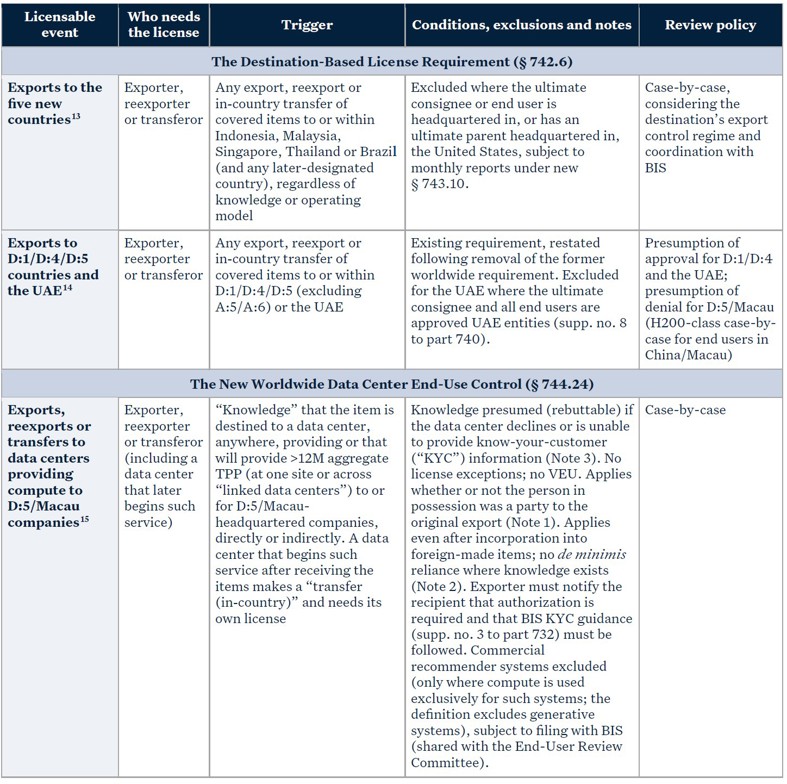
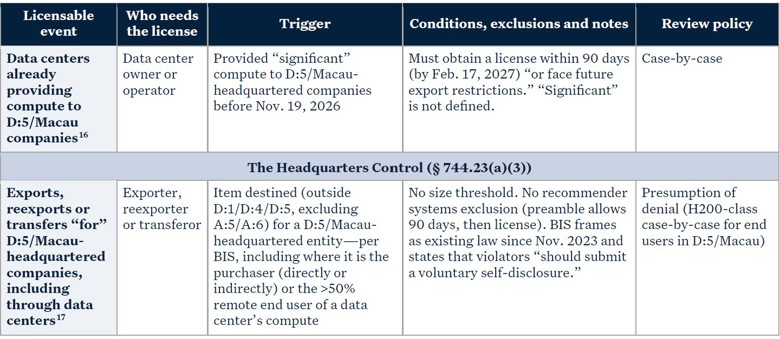
BIS may also impose license requirements on specific parties or destinations by an “is-informed” notice, including within 10 days of a State Department or National Security Advisor notice that a destination is high-risk.[18]
The IFR also removes the transistor-count attestation pathways for ICs designed by companies located in, or with ultimate parents in, D:1, D:4, D:5 or the five new countries, and adds a license requirement for front-end fabricators and OSATs exporting 3A090.a “applicable advanced logic integrated circuits” designed by non-approved, non-authorized designers.[19]
Key Questions the IFR Leaves Open
The IFR leaves several central terms undefined. How BIS resolves them—through FAQs, licensing decisions or a final rule—will shape how the rule operates in practice.
- What is a “data center”? The IFR does not say whether colocation facilities, GPU-as-a-service clouds, resellers or on-premises clusters are covered, which determines who must conduct customer diligence and who needs a change-in-end-use license.
- How is the 12 million aggregate TPP threshold measured? The IFR does not specify whether usage is counted per customer or across all D:5/Macau customers, on a contracted or actual basis, or at a point in time or cumulatively.
- What makes data centers “linked”? The definition reaches “digitally-linked” as well as physically linked infrastructure that shares resources, balances workloads and replicates data “as a unified whole,” which could aggregate capacity across sites. Within a single collocated multi-tenant site, it is also unclear whether separately owned tenants’ clusters are counted together.
- Do inference and API services count as “access”? Because the recommender system exclusion carves out generative systems, generative inference appears to be otherwise within scope, which would extend the obligations to model developers and model-as-a-service providers (e.g., API-only, token-based inference offerings), not only data center operators.
- How far does “for” a D:5/Macau company reach? The IFR counts compute provided to a non-D:5/Macau customer that trains or provides models for a D:5/Macau company. It is unclear how far that chain extends—for example, whether compute used by a non-D:5/Macau developer to train a model for its own purposes counts if the developer later licenses the model to, or makes it available to, a D:5/Macau company, and whether knowledge of that downstream use must exist when the compute is provided. The answer determines how far diligence must reach beyond a data center’s direct customers.
- Is the 50% figure a ceiling, a floor or an example? The IFR does not amend the text of the Headquarters Control. Instead, the preamble offers a new interpretation of the existing control, citing as an example data centers that provide more than 50 percent of their compute to D:5/Macau-headquartered remote end users. Because the 50 percent figure appears only in the preamble, introduced by “e.g.,” and not in the regulation, its status is unclear—BIS separately treats a D:5/Macau purchaser as sufficient, leaving open whether minority use can still be “for” a D:5/Macau entity and trigger the presumption of denial.
- What is “significant” compute, and what happens if a license is still pending on February 17, 2027? The IFR does not define “significant” for existing arrangements, though the 12M aggregate TPP threshold is presumed, and requires a license to be obtained within 90 days “or face future export restrictions” without addressing the status of service while an application is pending.
- Who can use the U.S.-headquarters exclusion? It is unclear whether a U.S.-headquartered customer of a non-U.S. operator qualifies, or only a U.S.-headquartered operator. Under the EAR, an end-user is defined as “the person abroad that receives and ultimately uses the exported or reexported items”[20]—ordinarily the data center operator—while the IFR seemingly treats customers as the users of a data center’s compute.
- Does the IFR reach compute located in the United States? BIS frames the controls as directed at “overseas” and “foreign” data centers, and the new control is triggered by an export, reexport or in-country transfer. The IFR does not expressly address U.S.-located facilities, or whether compute served to D:5/Macau customers from U.S. data centers that are “linked” to an operator’s foreign facilities counts toward the aggregate TTP threshold for those foreign facilities. Remote access legislation pending in Congress, if enacted, could reach U.S.-based operators directly.
- What does “authorization” for a change in end use require? Section 744.24(e) is framed as a “notification and authorization requirement for subsequent changes in end-use,” and refers to “BIS authorization” and “EAR authorization,” while the operative prohibition and the 90-day transition provision refer to a “license.” Because no license exceptions are available under § 744.24, a license appears to be the practical route, but the IFR does not say whether BIS contemplates a distinct or expedited process for foreign data center operators, whether authorization must be obtained before a data center begins serving covered customers or may follow a notification, or how the requirement applies to items exported before November 19, 2026.
Practical Pivot Points
- Diligence is the trigger in practice. The IFR builds a two-tier diligence structure. Data centers are expected to diligence their own customers for direct or indirect D:5/Macau ownership control, and to show lack of “knowledge,” the exporter is expected to obtain—and be able to produce—sufficient information about the customer diligence from the data center, in addition to its own KYC review. The diligence expectation sets no ownership percentage and reaches persons “located in” D:5/Macau, not only those headquartered there. If the data center declines or is unable to provide the information, the exporter is presumed to have knowledge unless the red flag is resolved, effectively making the exporter’s compliance position dependent on diligence performed by its customer.
- Foundry diligence tightens as well. Front-end fabricators and Outsourced Semiconductor Assembly and Test (“OSAT”) entities can no longer rely on transistor-count attestations where an IC designer is located in, or has an ultimate parent in, D:1, D:4, D:5 or one of the five newly covered countries, and need a license for 3A090.a ICs of designers that are neither approved nor authorized. The changes place greater weight on diligence into IC designers’ location, ownership and approval status, and may affect production arrangements for designers in the newly covered countries.
- Review policy may turn on overlap. Section 744.24 applications are reviewed case by case, but the § 742.6 presumption of denial for D:5/Macau-headquartered entities applies where an application meets more than one licensing policy. How often case-by-case review actually governs will depend on how BIS applies that tie-breaker.
- The threshold tightens over time. Because per-chip performance rises with each product generation, fewer chips will be needed to cross the 12 million aggregate TPP threshold.
- BIS’s Headquarters Control reading bears on past arrangements. BIS presents its reading as existing law since November 2023. That reading departs from what we understand to have been the prevailing industry interpretation, under which the “end user” of advanced computing items in a data center was the data center operator rather than its remote customers—an interpretation consistent with BIS’s own prior advisory opinion that the provision of computing capacity is not itself an export subject to the EAR.[21] Because BIS has now indicated that certain arrangements over the past three years may have violated the EAR, General Prohibition 10—which bars financing, servicing, transferring and other dealings in items with knowledge that a violation has occurred or is about to occur—may become relevant to future transactions involving affected hardware, including M&A, financing and data center transactions.[22]
Conclusion
The IFR significantly expands U.S. export controls over remote access to advanced computing, both prospectively and, through BIS’s reading of the Headquarters Control, retrospectively. Because its requirements operate cumulatively and turn on the jurisdiction to where hardware is exported and how much compute a data center provides and for whom, their application will depend heavily on the facts of each arrangement. Key dates include December 21, 2026 (savings clause), January 19, 2027 (comments) and February 17, 2027 (required date by which to receive a BIS license for existing arrangements). Shipments relying on the U.S.-headquarters exclusion also require monthly § 743.10 reports, due the first business day of the month following each shipment.
While impactful, the IFR is almost certainly not the last word on export controls applicable to the export and use of advanced computing items. Congress has shown bipartisan support for new legislative authority over remote access: the House passed the Remote Access Security Act 369-22 in January 2026, and a bipartisan Senate companion has gained cosponsors from both parties, although bills have remained in the Senate Banking Committee without action. In the House-passed version, the legislation could reach remote access to any item subject to the EAR, potentially including software accessed as a service.[23] Other significant rule changes also have the potential to affect industry in this area, including potential new additions to the Entity List and the scheduled expansion of Entity List Controls to affiliates on January 10, 2027. [24] We will continue to monitor developments, including BIS guidance, initial licensing decisions and the comments BIS receives.
* * *
[1] Bureau of Indus. & Sec., U.S. Dep’t of Com., Addressing Remote Access to Advanced Semiconductors, 91 Fed. Reg. 74970 (Nov. 19, 2026) (the “IFR”), available here.
[2] Exec. Order No. 14434, Inaugurating the Era of Super Intelligence, 91 Fed. Reg. 63129 (Oct. 2, 2026), available here.
[3] Press Release, Bureau of Indus. & Sec., BIS Issues Rule Addressing Remote Access to American Super Intelligence Technology (Nov. 16, 2026), available here.
[4] Total processing performance (“TPP”) is the EAR’s measure of an integrated circuit’s computing power, calculated as 2 × “MacTOPS” (the theoretical peak number of trillions of multiply-accumulate operations per second) × the bit length of the operation, aggregated over all processing units on the chip and evaluated at the highest value the manufacturer claims. 15 C.F.R. pt. 774, supp. no. 1, ECCN 3A090, Technical Note 2 to 3A090.a and 3A090.b. The IFR adds a new definition of “aggregate TPP,” which, when referring to a group of ICs or commodities (e.g., in a license application or other authorization), is the sum of the TPP of all of the ICs or commodities in the group specified in ECCNs 3A001.z, 3A090 (except 3A090.c), 4A003.z, 4A004.z, 4A005.z, 4A090, 5A002.z, 5A004.z and 5A992.z. 15 C.F.R. § 772.1 (definition of “aggregate TPP”).
[5] Country Group D:5 comprises the U.S. arms-embargoed destinations listed in supplement no.1 to part 740 of the EAR and includes China. Since December 2020, Hong Kong has been treated as part of China under the EAR, including for purposes of Country Group D:5. Macau remains a separate EAR destination outside Country Group D:5, which is why BIS names it separately. See Removal of Hong Kong as a Separate Destination Under the Export Administration Regulations, 85 Fed. Reg. 83765 (Dec. 23, 2020) (implementing Exec. Order No. 13936), available here. Accordingly, exports of covered advanced computing items to Hong Kong are treated as exports to China and are reviewed under the same presumption of denial (subject to the case-by-case policy for H200-class items and limited license exceptions), and a company headquartered in or located in Hong Kong is treated the same as one in mainland China under the IFR’s headquarters and diligence tests. Taiwan is not Country Group D:5.
[6] The EAR does not define “headquartered in” for this purpose, which may matter for groups with dispersed management or multiple holding companies.
[7] See Paul, Weiss, Department of Commerce Tightens Restrictions on the Export of Advanced Computing Chips and Semiconductor Manufacturing Equipment to China (Oct. 20, 2023), available here.
[8] Framework for Artificial Intelligence Diffusion, 90 Fed. Reg. 4544 (Jan. 15, 2025); Bureau of Indus. & Sec., U.S. Dep’t of Com., Department of Commerce Announces Rescission of Biden-Era Artificial Intelligence Diffusion Rule, Strengthens Chip-Related Export Controls, available here.
[9] Revision to License Review Policy for Advanced Computing Commodities, 91 Fed. Reg. 1684 (Jan. 15, 2026), available here.
[10] Bureau of Indus. & Sec., U.S. Dep’t of Com., Frequently Asked Questions about Guidance Regarding Enforcement of License Requirements for Advanced Computing Items for Entities Headquartered in Country Group D:5 and Macau (updated June 17, 2026), available here.
[11] H.R. 2683, 119th Cong. (2026), available here.
[12] U.S. Dep’t of State, Media Note, The San Francisco Declaration on the Secure Foundations of Enduring Prosperity (Nov. 15, 2026), available here.
[13] 15 C.F.R. § 742.6(a)(6)(iii)(A)(1).
[14] 15 C.F.R. § 742.6(a)(6)(iii)(A)(2).
[15] 15 C.F.R. § 744.24(a)(1), (e).
[16] 15 C.F.R. § 744.24(b)(3).
[17] 15 C.F.R. § 744.23(a)(3)(i)(A) (existing control).
[18] 15 C.F.R. § 744.24(a)(2).
[19] 15 C.F.R. § 744.23(a)(3)(i)(C); Note 1 to 3A090.a.
[20] Codified in 15 CFR Part 772 (§ 772.1).
[21] See Bureau of Indus. & Sec., U.S. Dep’t of Com., Advisory Opinion on Application of the EAR to Grid and Cloud Computing Services (Jan. 13, 2009), available here.
[22] 15 C.F.R. § 736.2(b)(10).
[23] See H.R. 2683, 119th Cong. (2026) (as passed by the House); S. 3519, 119th Cong. (2025), available here.
[24] Extension of the Suspension of Expansion of End-User Controls for Affiliates of Certain Listed Entities, 91 Fed. Reg. 70789 (Nov. 9, 2026), available here. For background on the Affiliates Rule and its suspension, see Paul, Weiss, White House Announces One-Year Suspension of Export Controls “Affiliates” Rule (Nov. 6, 2025), available here; Paul, Weiss, New Commerce Rule Applies Entity List and Other Restrictions to 50% or Greater Owned Foreign Affiliates (Oct. 2, 2025), available here.
Related Insights